

Platform Strategy - For CIOs
Executive Summary
Cloud adoption has become the default strategy for modern IT.
Yet many CIOs are facing a growing gap between expectations and reality:
- Rising and unpredictable cloud costs
- Increasing dependency on hyperscalers
- Limited control over infrastructure and architecture
- Fragmented tooling and operational complexity
- Growing security and compliance pressure
Key insight:
Using the cloud is not the same as building a modern IT platform.
The next step is not more cloud —
it is platform ownership.
The Problem with First-Generation Cloud
Most organizations have evolved from:
On-prem infrastructure → Lift-and-shift cloud
But this evolution is incomplete.
What’s going wrong
- Cloud replicates legacy architectures
- Costs scale faster than business value
- Operations remain manual and ticket-driven
- Security is fragmented across tools
- Vendor lock-in increases over time
Result: IT remains slow, expensive, and complex.
From Cloud to Platform Strategy
The real transformation is not technical — it is architectural.
Core shift
From:
Infrastructure-centric IT
To:
Platform-centric IT
What defines a platform?
- Standardized environments
- Self-service capabilities for developers
- Full automation (IaC, GitOps)
- Integrated security and compliance
- API-driven operations
IT becomes a product — a platform for the business.
Reference Architecture: Modern Platform Stack
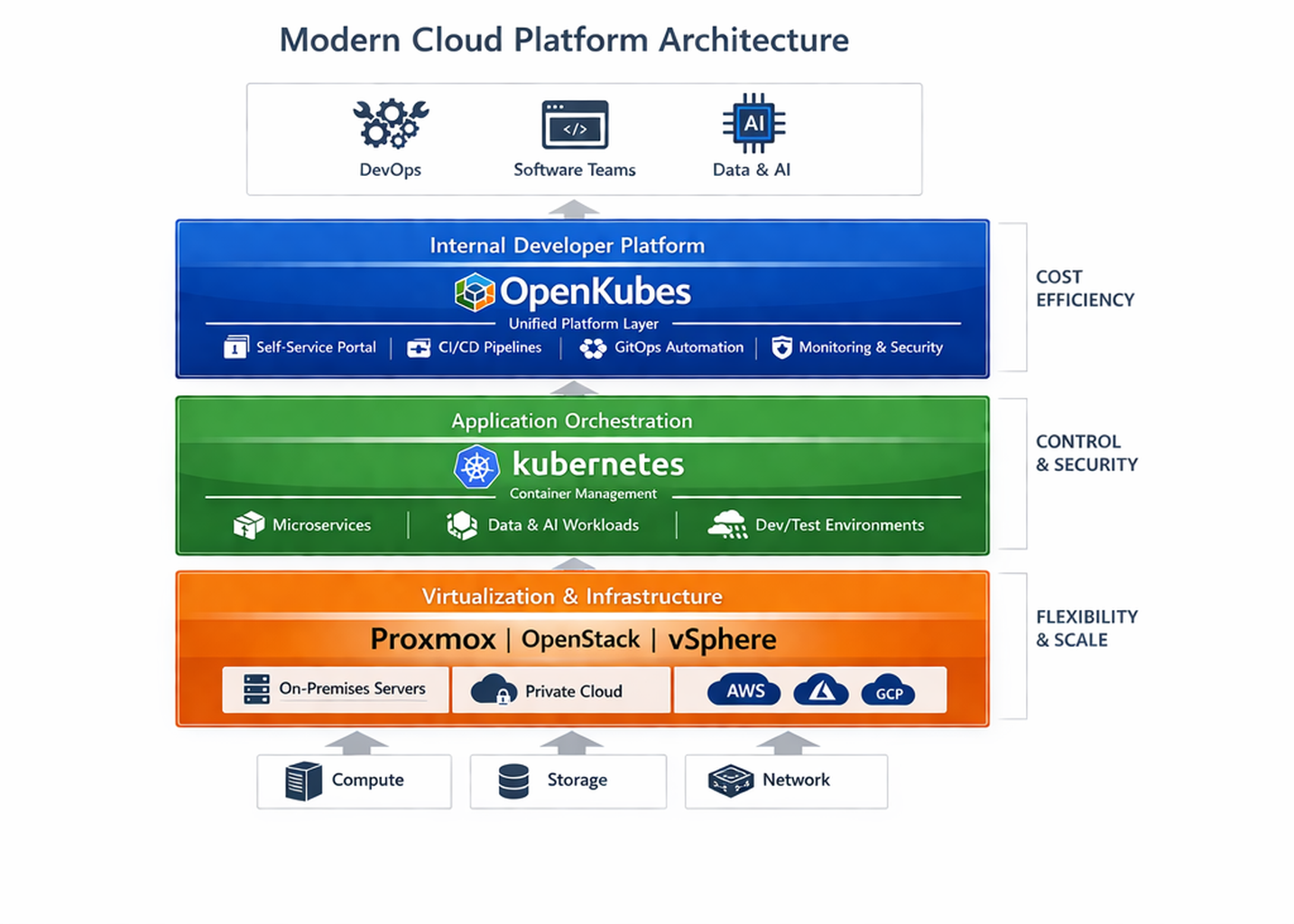
This layered architecture represents the modern platform model:
1. Infrastructure Layer
- Proxmox, OpenStack, vSphere
- On-prem, private cloud, public cloud
- Full control over compute, storage, network
2. Kubernetes Control Plane
- Standardized orchestration layer
- Runs all workloads (apps, data, AI)
3. Platform Layer (Internal Developer Platform)
- CI/CD pipelines
- GitOps automation
- Self-service portal
- Observability & security
Example: OpenKubes as unified platform layer
4. Consumer Layer
- DevOps teams
- Software teams
- Data & AI teams
Outcome:
Cost efficiency + control + developer productivity
Why Kubernetes Alone Is Not Enough
Many organizations stop at Kubernetes.
This creates:
- Operational complexity
- Lack of standardization
- Security gaps
- Tool fragmentation
Kubernetes is not the platform —
it is the control plane of the platform
What is missing?
- Platform services (CI/CD, GitOps)
- Identity & access control
- Security enforcement
- Observability
- Developer experience
Cybersecurity Must Be a Platform — Not a Tool
Security is no longer a separate layer.
It must be embedded into the platform itself
Cybersecurity Platform Architecture
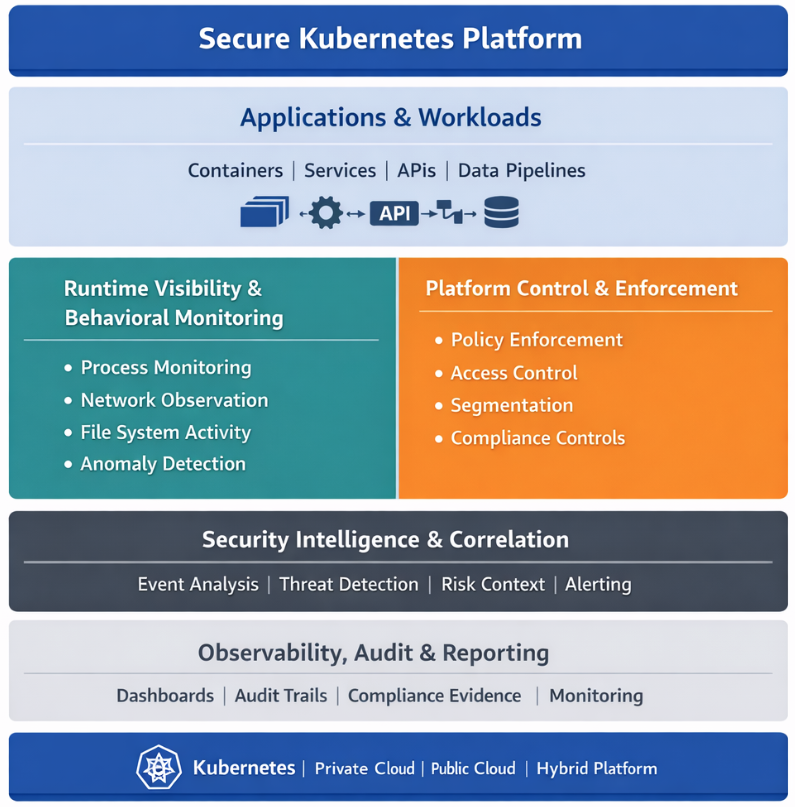
A modern security platform integrates:
Runtime Visibility & Behavioral Monitoring
- Process monitoring
- Network observation
- File system activity
- Anomaly detection
Platform Control & Enforcement
- Policy enforcement
- Access control (Zero Trust)
- Network segmentation
- Compliance controls
Security Intelligence & Correlation
- Event analysis
- Threat detection
- Risk context
- Alerting
Observability, Audit & Reporting
- Dashboards
- Audit trails
- Compliance evidence
- Continuous monitoring
Key principle:
Security is built-in, not bolted on.
The Rise of Internal Platforms (PaaS)
Modern enterprises are building internal developer platforms.
What they provide
- Standardized environments
- Automated deployments
- Built-in security & compliance
- Self-service for teams
Business impact
- Faster time-to-market
- Lower operational cost
- Higher developer productivity
- Audit-ready infrastructure
Take Back Control: Open Platforms
The strategic shift:
From proprietary stacks → to open platforms
Why this matters
- Avoid vendor lock-in
- Reduce cloud and license costs
- Maintain architectural control
- Enable hybrid & multi-cloud flexibility
Platform approach
- Kubernetes-based control plane
- Automated via Terraform, Ansible, GitOps
- Runs anywhere: on-prem, cloud, hybrid
Example: OpenKubes
A unified platform layer enabling:
- Standardization
- Automation
- Security by design
- Operational efficiency
The CIO Decision
CIOs now face a fundamental choice:
Continue as today
- Increasing costs
- Growing vendor dependency
- Rising complexity
- Fragmented security
Or move to a platform model
- Full control
- Predictable cost
- Integrated security
- Faster innovation
The winners will not be cloud users —
but platform builders.
Book a Platform Strategy Session
Now is the time to rethink your cloud strategy.
We help organizations:
- Define platform strategies
- Build Kubernetes-based platforms
- Implement cybersecurity platforms
- Reduce vendor dependency
- Modernize infrastructure (on-prem, hybrid, multi-cloud)